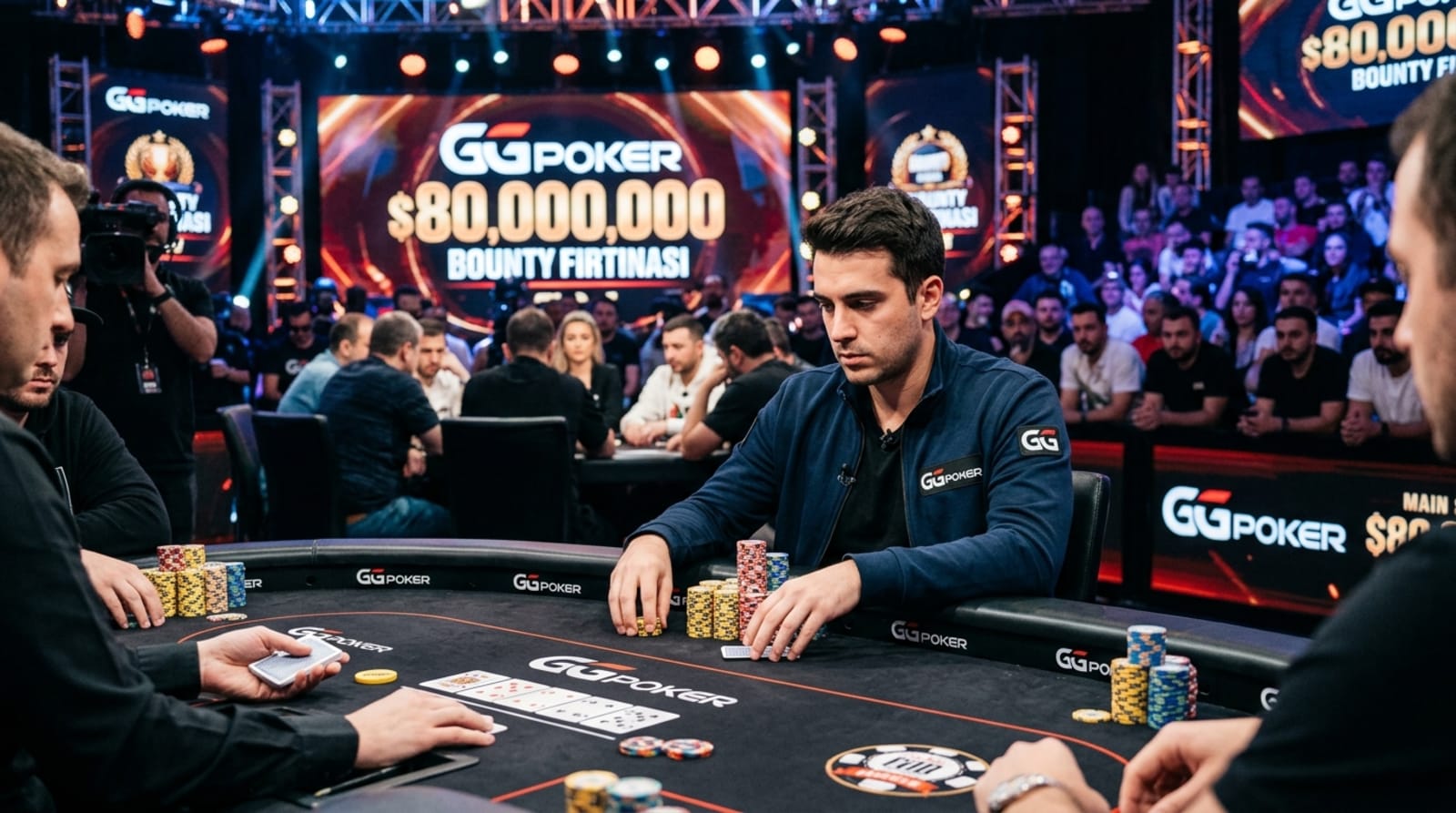

⚡ TL;DR — Strategic SummaryBounty tournaments with massive guaranteed prize pools require a three-dimensional strategy: (1) aggressive pre-flop ranges targeting short stacks with bounties on their heads, (2) recalculated pot odds that factor in bounty equity, and (3) disciplined bankroll management that accounts for high variance. Players who understand these adjustments hold a measurable edge over opponents playing standard tournament strategy. This guide breaks down every critical decision point with actionable tactics you can apply at the tables immediately.
When a poker platform announces a tournament series with a combined guarantee surpassing $80 million, the strategic landscape shifts dramatically. These are not ordinary tournaments. The bounty mechanics, field sizes, and prize distributions demand a completely recalibrated approach to every street, every decision, and every chip in your stack.
According to data from major tracking sites like PokerTracker and Hold'em Manager, the average ROI for recreational players in progressive knockout (PKO) tournaments sits at -12%, while studied regulars show positive ROI of +18% to +34% in the same formats. The gap is entirely explained by strategic adjustments — or the lack of them.
In this comprehensive guide, we dissect the five strategic pillars you must master to compete effectively in high-guarantee bounty tournament series: pre-flop range construction, pot odds with bounty equity, positional exploitation, bankroll allocation, and hand range analysis during bubble dynamics.
What Exactly Is a Progressive Knockout (PKO) Tournament and Why Does It Change Everything?
In a standard tournament, your buy-in goes entirely into the prize pool. In a Progressive Knockout tournament, a portion of your buy-in — typically 50% — forms your "bounty." When you eliminate another player, you collect half their bounty immediately and the other half is added to your own bounty.
This creates a compounding mechanic. A player who has eliminated multiple opponents carries a large bounty, making them a high-value target — but also a dangerous opponent with a deep stack. The strategic implications ripple through every decision from the first hand to the final table.
| Tournament Format | Bounty Structure | Strategic Priority | Recommended Aggression Level |
|---|---|---|---|
| Standard Freezeout | None | Survival + Stack Growth | Moderate |
| Flat Knockout | Fixed per elimination | Chase short stacks | High |
| Progressive Knockout (PKO) | 50% keep / 50% added | Bounty EV + ICM | Very High |
| Super Bounty | Large fixed bounty | Bounty hunting only | Maximum |
Table 1: Tournament format comparison with strategic priority and aggression recommendations.
How Should You Adjust Your Texas Hold'em Pre-Flop Strategy in High-Guarantee Bounty Events?
Pre-flop strategy is the foundation of your entire game, and in PKO tournaments, the adjustments are significant. The core principle is straightforward: when a player has a bounty worth calling, your effective pot odds improve dramatically, justifying wider calling and shoving ranges.
The Bounty-Adjusted Opening Range Framework
In standard tournaments, your pre-flop opening ranges are primarily determined by position and stack depth. In PKO events, you must add a third variable: bounty equity. Here's how it works in practice:
Suppose you're playing a $109 PKO tournament. The bounty component is $54.50 per player. Your opponent is a short stack with 12 big blinds, and their accumulated bounty is worth $218 (four times the initial bounty). If you go all-in and they call, you have a realistic chance at $109 in immediate cash (50% of their $218 bounty) plus adding the remaining $109 to your own bounty.
That bounty equity allows you to call profitably with hands you'd normally fold in a standard tournament. According to ICMIZER 3 simulations, this can expand your pre-flop calling range by 15-22 percentage points when the bounty-to-stack ratio is high.
- Rule 1: Calculate bounty-to-call ratio before making any pre-flop call decision
- Rule 2: Widen your shoving range by 8-12% when targeting bounty-rich short stacks (<15BB)
- Rule 3: Maintain tight ranges in early position — position still matters fundamentally
- Rule 4: Never over-loosen your range against players who cover your stack
- Rule 5: In the big blind, defend wider against short-stack shoves by precisely 1.5x the bounty-adjusted calling threshold
Position Play: Why Button and Cutoff Seats Print Money in PKO Formats
Position play fundamentals become even more powerful in PKO tournaments. When you're in the button or cutoff, you can put maximum pressure on bounty-holding players in the blinds with a significant stack advantage. Studies by Run It Once Pro players show that button steal attempts increase win rates in PKO formats by approximately